
AI for Social Media: What’s Changing Right Now
Introduction
Social media work hasn’t dramatically “flipped” overnight — it has quietly evolved. Content that once relied on manual planning, instinct-based posting, and trial-and-error is now influenced by systems that continuously learn from user behavior in real time.
This shift is why creators, brands, and marketers can’t afford to ignore what’s happening behind the scenes anymore. A single mention of AI for Social Media now feels unavoidable because it’s already embedded into how platforms function, distribute content, and measure success.
The Silent Shift Happening Inside Social Platforms
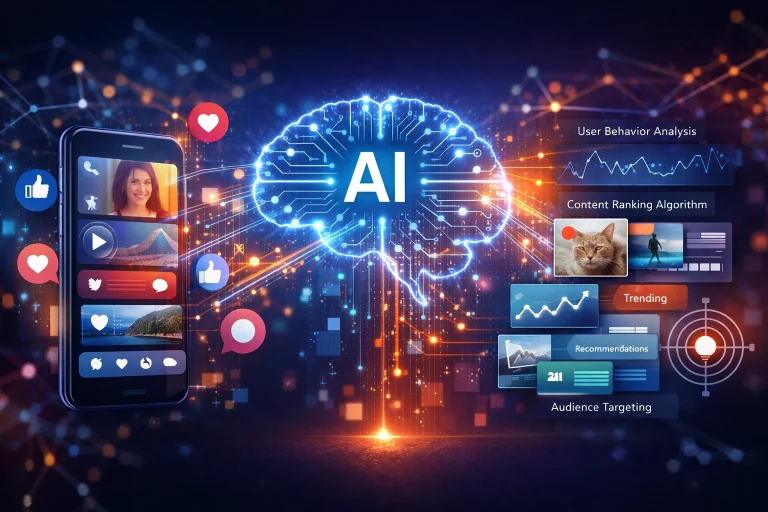
Social platforms are becoming smarter without making it obvious to users. What people experience as “better recommendations” or “changed reach” is the result of systems constantly adapting to behavior patterns.
In simple terms, artificial intelligence in social media helps platforms decide what to show, when to show it, and to whom, based on how users interact — not just what they follow.
This is why feeds feel different today: reach fluctuates faster, engagement patterns shift quicker, and content relevance matters more than posting volume.
From Manual Posting to Smart Assistance
Content planning has shifted away from fixed schedules and guesswork. Instead of manually deciding every detail, creators now work with systems that suggest improvements based on performance patterns.
The use of AI in Social Media can be seen in how captions are refined, posting times are optimized, and hashtag suggestions are generated — all based on audience activity rather than assumptions. This reduces wasted effort and helps content align better with real user behavior.
AI Tools Are Changing How Content Gets Created

AI tools for Social Media are reshaping how creators approach content, not by replacing ideas, but by speeding up execution.
What’s happening now is a shift from starting from scratch to starting with informed direction.
This matters because consistency and speed have become just as important as creativity.
Faster idea and caption development
Instead of facing a blank screen, creators now begin with structured prompts or refined drafts.
This supports brainstorming, sharpens messaging, and helps captions align with platform tone without losing originality.
Visual and format support for different platforms
Content is now adapted for feeds, reels, and stories more efficiently.
This reduces trial-and-error in layout, sizing, and format choices while keeping visuals platform-appropriate.
Smarter publishing without manual guesswork
Posting decisions are increasingly influenced by audience activity patterns.
This allows reach and engagement to improve naturally, without relying on fixed posting rules.
What Actually Goes On Behind the Algorithm
At the core of social platforms is machine learning — systems that improve by observing patterns.
Platforms learn from what users pause on, skip, replay, save, or interact with over time.
The AI technology behind social media apps doesn’t rank content randomly. It continuously adjusts distribution based on how similar users respond, making engagement signals more important than follower count alone.
Smarter Decisions Through Data, Not Guesswork
Insights today go far beyond likes and shares. Platforms now anallyze watch time, retention, interaction depth, and behavioural consistency.
With social media analytics machine learning, strategies are built on performance patterns instead of assumptions.
This is why data-backed decisions matter more now — they reduce wasted effort and help creators focus on what actually works.
How Brands Are Using AI Without Losing the Human Touch
Brands are using AI to support planning, testing, and optimization — not to remove creativity.
An effective AI social media strategy focuses on improving efficiency while keeping messaging authentic.
Automation handles repetitive tasks, while humans remain responsible for storytelling, emotion, and brand voice. The balance is what drives sustainable engagement.
Ads, Targeting, and Performance Optimization
Ad performance has improved because platforms adjust delivery based on real-time interaction signals.
AI facebook ad optimization helps ads reach users who are more likely to engage, rather than relying only on broad targeting.
This shift benefits smaller brands the most, as budgets are used more efficiently and learning happens faster.
Ethical Questions We Can’t Ignore Anymore
As AI becomes more embedded, concerns around trust, originality, and transparency are increasing.
The ethical issues of AI in social media now include content authenticity, disclosure, and data responsibility.
Platforms and creators are being watched more closely, making ethical use just as important as performance.
Where Social Media AI Is Headed Next
In the short term, platforms will continue refining personalization and performance measurement.
Long-term changes point toward deeper content relevance and smarter distribution systems.
The future of AI in social media isn’t about automation replacing humans — it’s about systems becoming better at supporting meaningful content decisions. Marketers should prepare by learning how to work with these systems, not against them.
What This Means for Creators and Brands
AI isn’t replacing creativity — it’s reshaping workflows.Creators and brands that adapt early gain clarity, speed, and consistency.
The key takeaway is simple: understanding how AI and Social Media now work together is no longer optional — it’s essential for staying visible, relevant, and competitive.
For creators and businesses looking to turn these changes into measurable growth, working with a Social Media Marketing expert helps bridge the gap between technology and human storytelling. A well-planned approach ensures AI-driven insights are applied intentionally — improving reach, engagement, and conversions while maintaining a consistent and authentic brand voice.